Known as the moon bear for the pale crescent-shaped patch on its chest, the Asian black bear is a medium-sized, highly arboreal species found across a vast swathe of southern and eastern Asia. Despite its wide range, the species faces severe threats from habitat destruction and illegal wildlife trade.
Quick Facts
Distribution & Habitat
Asian black bears have one of the broadest ranges of any Asian bear. They are found from Iran and Afghanistan in the west, across the Himalayas, through Southeast Asia, and into China, Korea, Japan, and the Russian Far East. Seven subspecies are currently recognized, adapted to environments as varied as the tropical forests of Indochina and the cold temperate forests of Manchuria and Japan.
They typically favor deciduous and mixed forests at elevations between 1,000 and 3,500 meters, though lowland populations exist in some regions. In the Himalayas, they may seasonally move to higher altitudes during summer to follow fruiting trees and descend to warmer valleys in winter.
Physical Characteristics
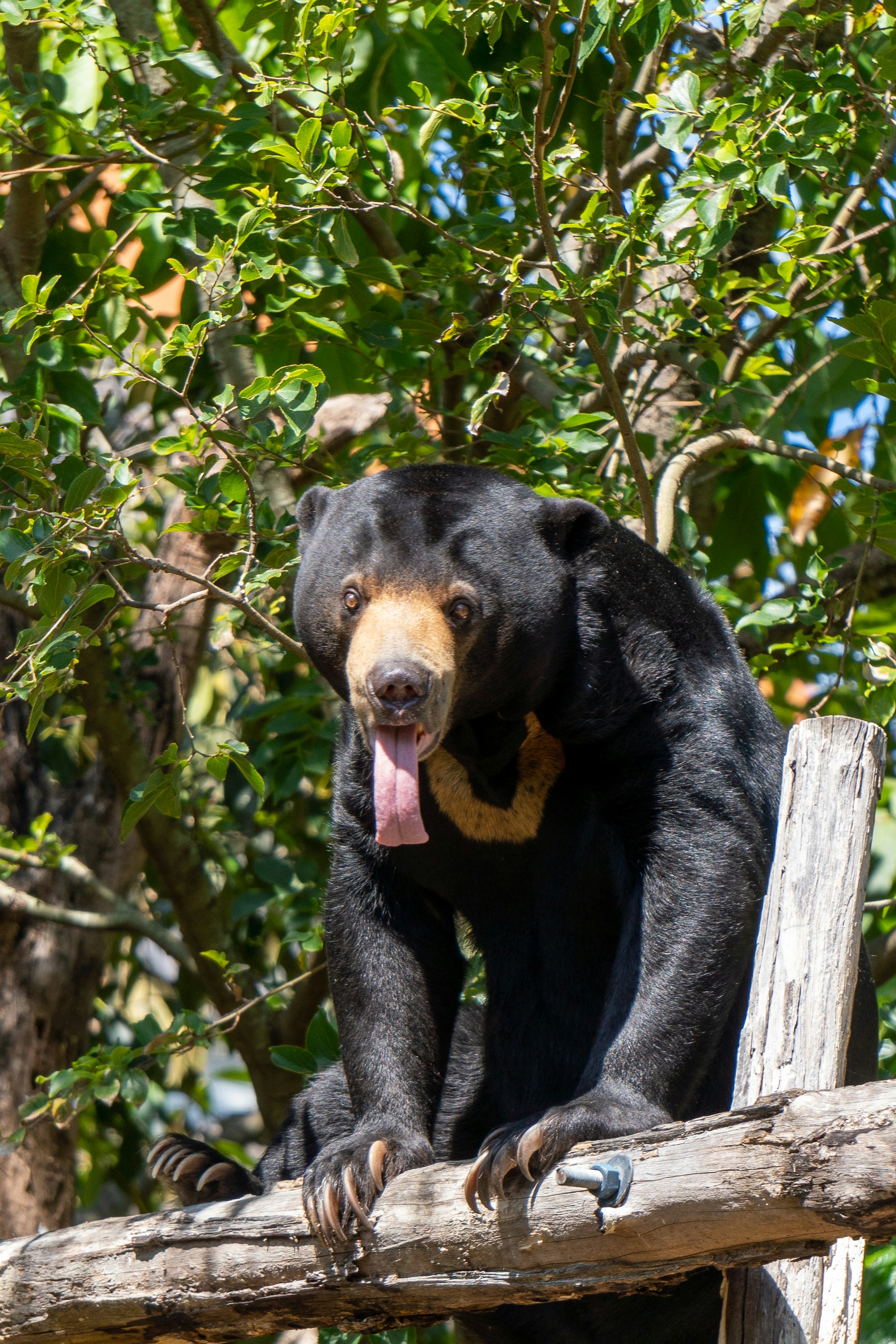
The most distinctive feature of the Asian black bear is the cream or white V-shaped or crescent-shaped patch on its chest — the feature that earns it the common name "moon bear." Their fur is typically jet black and notably shaggy, particularly around the neck and shoulders, giving them an almost mane-like ruff.
They have large, rounded ears that are proportionally bigger than those of most other bear species, contributing to their excellent hearing. Adults typically weigh between 60 and 200 kilograms, with males being considerably larger than females. Their claws are short, strong, and curved — ideal for climbing.
Diet & Foraging
Moon bears are omnivores with a diet heavily skewed toward plant material. Fruits, nuts, acorns, and berries form the bulk of their food, supplemented by insects such as beetle larvae and ants, honey, and occasionally small vertebrates or carrion. In autumn, they feed intensively on mast crops — particularly acorns and walnuts — to build fat reserves.
Their arboreal habits play a significant role in foraging. Moon bears frequently climb trees to reach fruit, and they construct what are sometimes called "bear nests" — platforms of broken branches in the tree canopy created as the bear pulls fruiting branches toward itself to feed.
Behavior & Reproduction
Asian black bears are primarily nocturnal or crepuscular, spending much of the day resting in tree hollows or dense vegetation. They are solitary outside of mating season and mother-cub associations. In the northern parts of their range, they hibernate during winter, often in hollow trees or caves.
Mating typically occurs from June to August. After delayed implantation, females give birth during winter dormancy, usually to one or two cubs. The cubs are tiny at birth — roughly 300 grams — and remain with their mother for 18 to 24 months. Females typically reproduce every two to three years.
Threats & Conservation
The Asian black bear is classified as Vulnerable by the IUCN, with populations declining across most of its range. The two primary threats are habitat loss due to logging and agricultural expansion, and poaching for the illegal wildlife trade.
Bear bile farming remains one of the most pressing welfare and conservation issues facing this species. In several Asian countries, moon bears have been captured and confined in small cages to have their bile extracted, which is used in traditional medicine. Organizations such as Animals Asia Foundation have campaigned for decades to end this practice and have rescued hundreds of bears from bile farms.
Protected areas and anti-poaching patrols are critical to the species' survival. In Japan and South Korea, populations are relatively stable due to stronger legal protections and enforcement. In Southeast Asia and parts of China, however, enforcement remains inconsistent and habitat continues to be fragmented.