The spectacled bear is the only bear species native to South America and the last surviving member of the short-faced bear subfamily Tremarctinae, which once included the massive Arctotherium of the Pleistocene. Found in the cloud forests and páramo grasslands of the Andes, it is one of the most elusive and least studied bears on Earth.
Quick Facts
Distribution & Habitat
Spectacled bears range along the Andes from western Venezuela through Colombia, Ecuador, Peru, and Bolivia, with small populations in northern Argentina. Their range spans an enormous elevational gradient — from as low as 200 meters in coastal scrublands to over 4,700 meters in the high-altitude páramo grasslands above the tree line.
Their preferred habitat is the Andean cloud forest, a perpetually misty, moss-draped ecosystem rich in epiphytes and bromeliads. These forests provide both food and cover. Spectacled bears will also venture into dry forests, grasslands, and even agricultural areas, though they tend to avoid areas of intense human activity.
Physical Characteristics
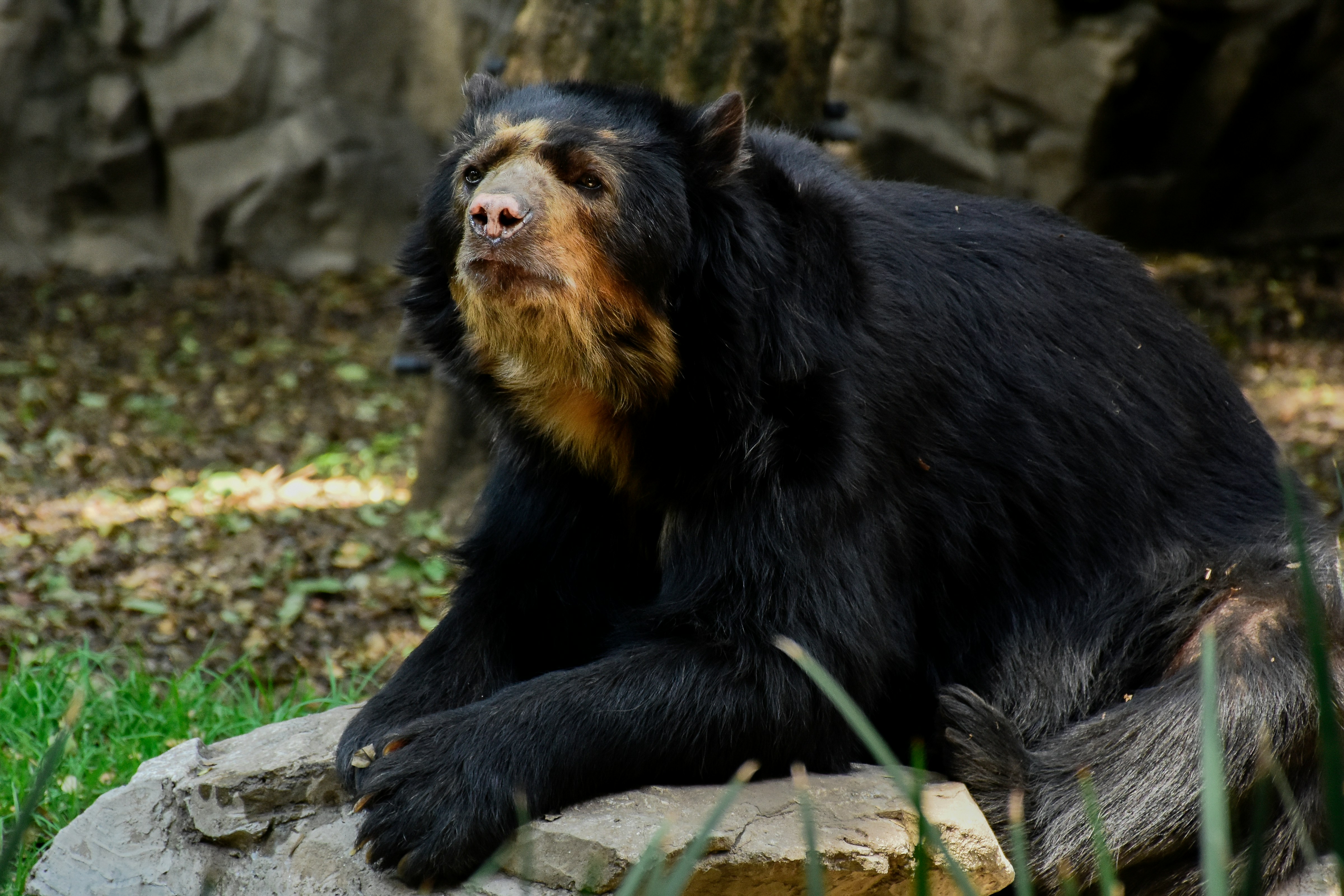
The spectacled bear gets its name from the distinctive beige or ginger markings that encircle its eyes and extend onto the throat and chest. These patterns are unique to each individual — much like a fingerprint — and serve as the primary method researchers use to identify bears in the field through camera-trap photographs.
Their fur is predominantly black or dark brown, and they are medium-sized relative to other bears. Males typically weigh between 100 and 200 kilograms, while females are considerably smaller at 60 to 80 kilograms. They have a relatively short, broad muzzle and powerful jaw muscles adapted for crushing the tough plant material that dominates their diet.
Diet & Foraging
Spectacled bears are the most herbivorous of all bear species outside the giant panda. Plant material — including bromeliads, palm fronds, cactus, fruits, and orchid bulbs — can account for up to 95 percent of their diet in some populations. They are particularly associated with bromeliads, which they rip apart to consume the soft heart of the plant.
Like moon bears, spectacled bears are highly arboreal and construct feeding platforms in trees by breaking and folding branches. They are also known to feed on crops such as corn, which brings them into conflict with farmers. Animal prey is uncommon but documented and includes insects, rodents, and occasionally livestock or carrion.
Behavior & Reproduction
Spectacled bears are shy, solitary animals that are primarily active during dawn and dusk. They are powerful climbers and spend significant time in trees — both foraging and resting. In some regions, they build day nests in the canopy where they sleep. They do not hibernate, as the tropical and subtropical climate of their range provides year-round access to food.
Reproductive biology in wild spectacled bears is still not fully understood due to the difficulty of studying them in their remote habitat. Mating appears to occur between April and June. After delayed implantation, one to three cubs are born between November and February, typically in a secluded den. Cubs remain with their mother for at least one year, often riding on her back during travel — a behavior more pronounced in this species than in other bears.
Evolutionary Significance
The spectacled bear holds a unique position in bear evolution. It is the sole surviving member of the subfamily Tremarctinae, the short-faced bears, which were once widespread across the Americas. Its closest relatives include the extinct Arctodus simus, the giant short-faced bear of North America, and Arctotherium angustidens, which may have been the largest bear ever to have lived. Understanding the spectacled bear thus offers a living window into a lineage millions of years old.
Conservation
The spectacled bear is classified as Vulnerable by the IUCN, with an estimated total wild population of perhaps 10,000 to 20,000 individuals, though reliable census data is scarce. The primary threats are habitat loss from agricultural expansion, illegal hunting — both retaliatory killing by farmers and poaching for body parts used in traditional practices — and mining activity in Andean forests.
Conservation programs across the Andes focus on community-based approaches: compensating farmers for livestock losses, promoting bear-friendly agriculture, establishing biological corridors between fragmented forest patches, and environmental education. Ecuador, Peru, and Colombia have designated spectacled bears as flagship species for Andean conservation, and several protected areas have been created or expanded with the bear as a focal point.
The spectacled bear is also a culturally significant animal in Andean communities, appearing in indigenous folklore and serving as the inspiration for the fictional character Paddington Bear, who hails from "Darkest Peru."