The polar bear is the largest living land carnivore and one of the most perfectly adapted predators on Earth. Evolved to thrive in the extreme cold of the Arctic, it has become an iconic symbol of both wilderness grandeur and the urgent threat of climate change.
Quick Facts
Distribution & Habitat
Polar bears are found throughout the circumpolar Arctic in five nations: Canada, Russia, the United States (Alaska), Norway (Svalbard), and Denmark (Greenland). Canada is home to roughly two-thirds of the world's polar bears, which are divided into 19 recognized subpopulations.
Unlike most bears, polar bears are classified as marine mammals because they depend on the ocean — specifically sea ice — for their survival. Sea ice serves as a platform from which they hunt seals, their primary prey. During summer months when sea ice retreats, some populations are forced ashore, where they live largely off stored fat reserves until the ice returns.
Physical Characteristics
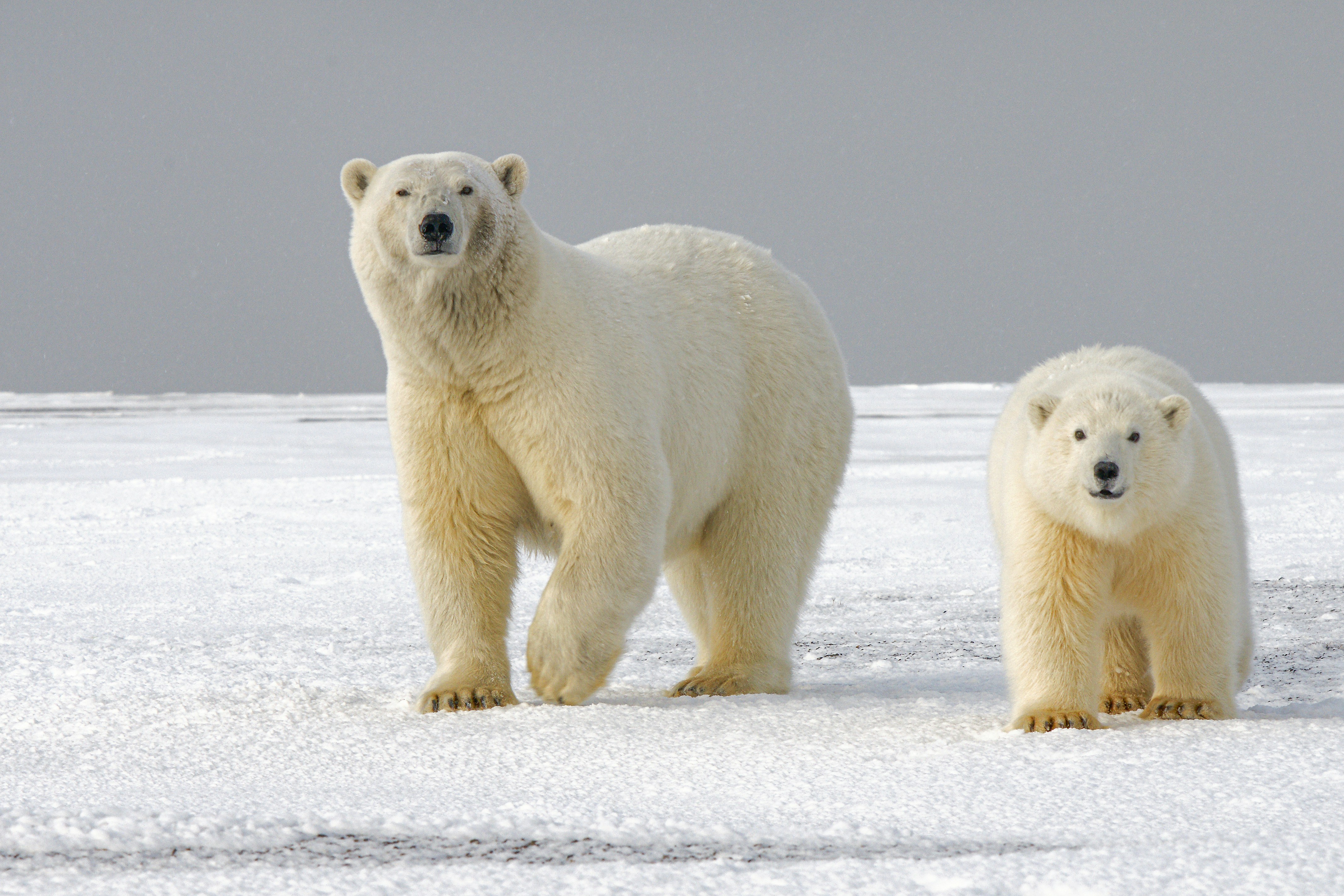
Polar bears are powerfully built predators with several remarkable adaptations to Arctic life. Their fur appears white or cream-colored but is actually composed of transparent, hollow hairs that scatter light. Beneath the fur, their skin is black, which helps absorb heat from the sun.
They possess a thick layer of blubber — up to 11 centimeters thick — that provides both insulation and energy storage. Their large, slightly webbed front paws act as efficient paddles for swimming and as snowshoes for distributing weight on thin ice. Adult males typically weigh between 350 and 700 kilograms, making them the largest extant bears.
Diet & Hunting
Polar bears are hypercarnivores, meaning that animal matter constitutes more than 70 percent of their diet. Ringed seals are their primary prey, followed by bearded seals. Their primary hunting technique, called still-hunting, involves waiting motionless beside a seal's breathing hole in the ice — sometimes for hours — and striking when the seal surfaces to breathe.
They also stalk seals resting on ice and raid the birth lairs of ringed seals in spring. When seal hunting is not possible — particularly during ice-free summer months — polar bears may scavenge whale carcasses, eat bird eggs, forage on seaweed, or, increasingly, come into contact with human communities in search of food.
Behavior & Reproduction
Polar bears are generally solitary animals, with the exception of mothers with cubs and temporary aggregations at food sources such as whale carcasses. Unlike most bear species, polar bears do not typically hibernate, though pregnant females enter maternity dens in autumn.
Mating occurs in spring, with delayed implantation ensuring that cubs are born in the shelter of the den during the harsh Arctic winter, usually in December or January. Litters consist of one to three cubs, most commonly twins. Cubs are born blind and covered in fine hair, weighing about 600 grams. They nurse in the den for several months before emerging with their mother in March or April. Young bears stay with their mother for approximately two and a half years.
Climate Change & Conservation
The polar bear is classified as Vulnerable by the IUCN, with climate change representing the single greatest threat to the species. Arctic sea ice — the foundation of polar bear ecology — has declined dramatically in both extent and thickness over recent decades. This trend is projected to accelerate, with some models predicting largely ice-free Arctic summers within this century.
As sea ice diminishes, polar bears are forced to spend longer periods ashore, where they have limited access to their primary prey. This leads to declining body condition, lower reproductive success, and increased human-bear conflict as hungry bears venture into communities. Several subpopulations, particularly in the southern Beaufort Sea and western Hudson Bay, have already shown measurable declines linked to ice loss.
Conservation measures include protected denning areas, management of human-bear interactions in Arctic communities, international cooperation through the Agreement on the Conservation of Polar Bears (1973), and broader efforts to address global greenhouse gas emissions. Research and monitoring programs track population trends and health indicators to inform management decisions.